
 KUMARAN. V
Semiconductor production, particle physics analysis, and different precious processes happen in high-vacuum or ultra-high-vacuum (HV/UHV) stipulations. To assist expand a greater ionization gauge for measuring stress in HV/UHV environments, software producer INFICON of Liechtenstein used multiphysics modeling to check and refine its spectacular new design. The Ion Reference Gauge 080 (IRG080), proven in Determine 1, resulted from a global challenge coordinated through the Ecu Metrology Programme for Innovation and Analysis (EMPIR) to expand a greater device for quantifying stress in HV/UHV environments.
“At HV/UHV pressures, there aren’t sufficient debris to drive a diaphragm to transport, nor can we reliably measure warmth switch. That is the place we use ionization to decide fuel density and corresponding stress,” stated Martin Wüest, head of sensor era at INFICON.
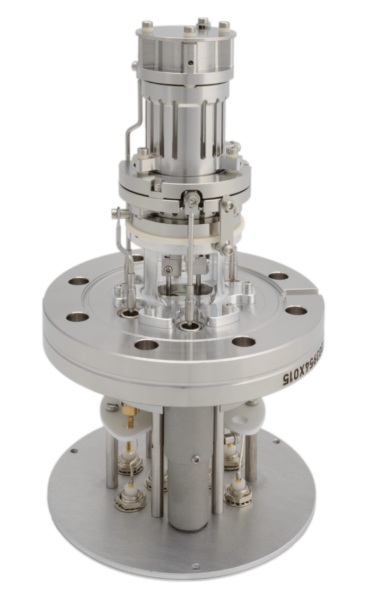
Essentially the most usually used HV/UHV pressure-measuring device is a Bayard–Alpert hot-filament ionization gauge positioned throughout the vacuum chamber. The center of this software is composed of the filament (or sizzling cathode), the grid, and the ion collector. Its operation begins with supplying low-voltage electrical present to the filament, inflicting it to warmth up. Because the filament turns into warmer, it emits electrons which are interested in the grid, which is provided with upper voltage. Some electrons flowing towards and throughout the grid will collide with any free-floating fuel molecules circulating within the vacuum chamber. Electrons that collide with fuel molecules shape ions that glide towards the collector. This measurable ion present within the collector can be proportional to the density of fuel molecules within the chamber.
“We will then convert density to stress, in step with the perfect fuel legislation,” Wüest stated. “Force can be proportional to the ion present divided through the electron present, divided through a sensitivity issue this is adjusted relying on what fuel is within the chamber.”
Whilst the operational rules of those units are sound, their calibration is just too simply compromised through regimen use and dealing with. Along side their sensitivity to warmth, the core elements of a Bayard–Alpert gauge can turn into simply misaligned. This may introduce size uncertainty of 10 to twenty% — an unacceptably wide variety of variation.
The challenge group selected INFICON’s IE514 extractor-type gauge as the present very best observe for ionization gauge design. Francesco Scuderi, an INFICON engineer that specialize in simulation, used the COMSOL Multiphysics tool to fashion the IE514.
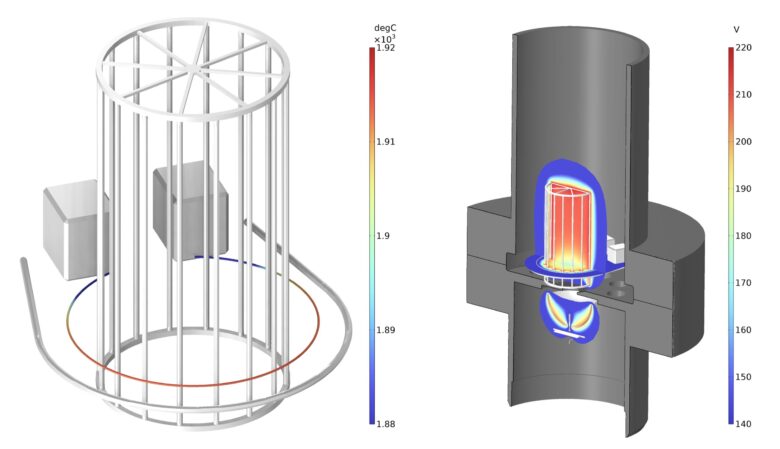
“After setting up the fashion geometry and mesh, we set boundary stipulations for our simulation,” stated Scuderi. “We need to specific the coupled dating of electron emissions and filament temperature, which can range from roughly 1400 to 2000° C around the period of the filament. This modification thermionically impacts the distribution of electrons and the trails they’ll observe.” (Determine 2)
Subsequent, the fashion was once used to calculate the proportion of electrons that collide with fuel debris. From there, ray tracing of the ensuing ions was once carried out, tracing the ions’ paths towards the collector (Determine 3).
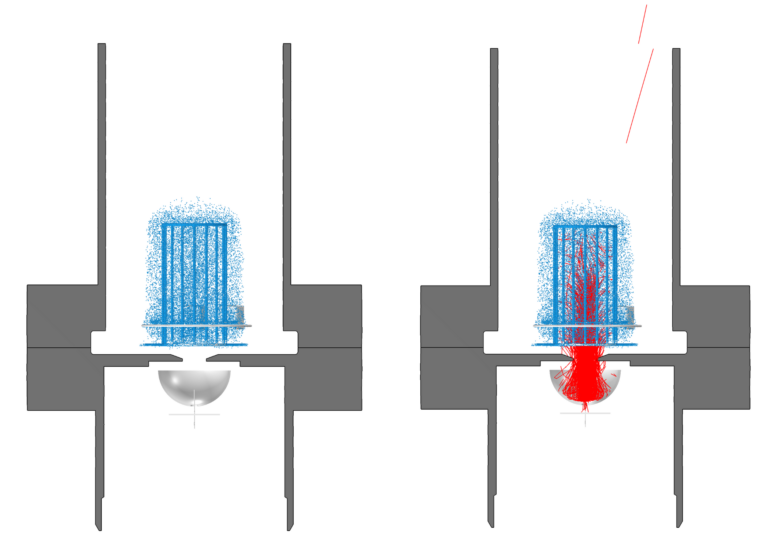
“We will then examine the amount of circulating electrons with the selection of ions and their positions. From this, we will extrapolate a worth for ion present within the collector after which compute the sensitivity issue,” stated Scuderi.
INFICON’s fashion did an outstanding task of producing simulated values that carefully aligned with check effects from the benchmark prototype. This enabled the group to look at how adjustments to the modeled design affected key metrics, together with ionization power, the trails of electrons and ions, emission and transmission present, and sensitivity.
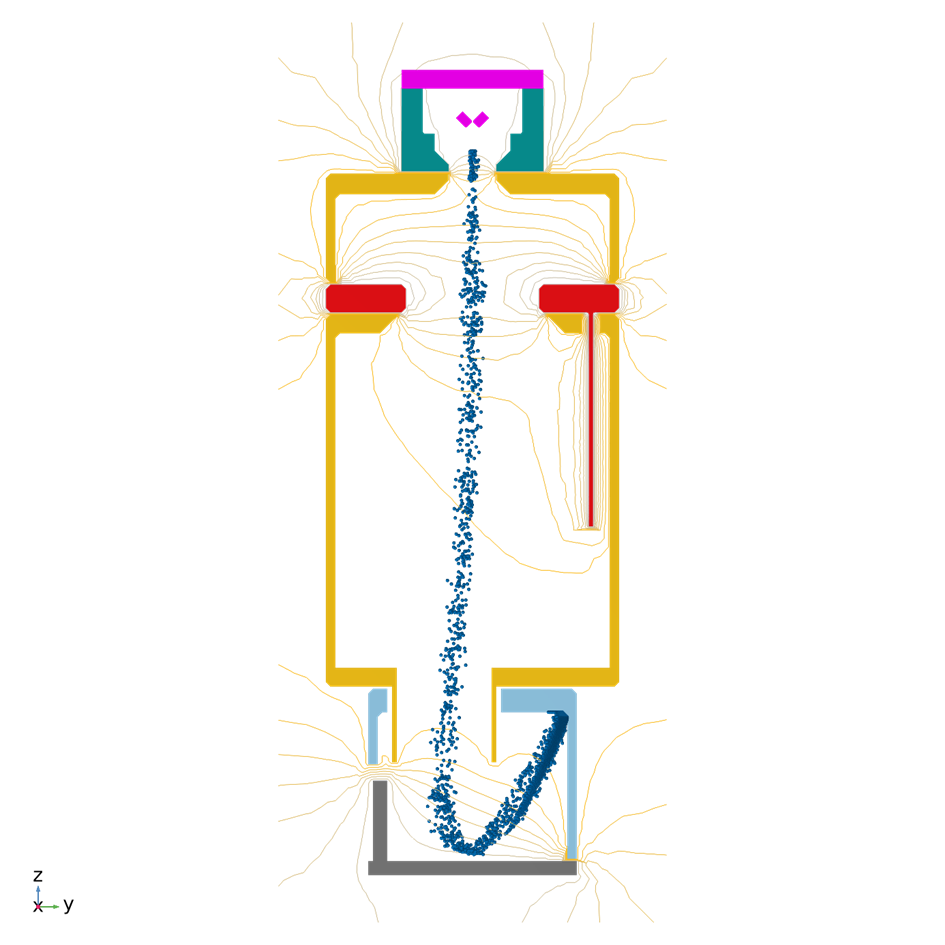
The tip fabricated from INFICON’s design procedure, the IRG080, comprises many elements as current Bayard–Alpert gauges, however key portions glance fairly other. For instance, the brand new design’s filament is a cast suspended disc, no longer a skinny cord. The grid is now not a mild cord cage however comprised of stronger-formed steel portions. The collector now is composed of 2 elements: a unmarried pin or rod that pulls ions and a cast steel ring that is helping direct electron glide clear of the collector and towards a Faraday cup. This association, subtle via ray tracing simulation, improves accuracy through higher keeping apart the trails of ions and electrons (Determine 4).
INFICON constructed 13 prototypes that underwent analysis through the challenge consortium. Trying out confirmed that the IRG080 accomplished the function of lowering size uncertainty to beneath 1%. Relating to sensitivity, the IRG080 carried out 8 instances higher than the benchmark.
After all, this good fortune was once no longer the group’s on my own. INFICON benefited from its companions’ insights and beef up, and in flip, the wider medical and production group will take pleasure in extra constant measurements of HV/UHV stipulations.
Talk over with COMSOL’s person tale gallery to learn the entire case learn about, Raising the efficiency of ionization gauges with simulation.
COMSOL
www.comsol.com
INFICON
www.inficon.com