
 KUMARAN. V
This newsletter was once contributed via Garrett Clyma, CFD Engineer at Float Science.
Soften pool waft dynamics is a essential and incessantly lost sight of side of the steel Three-D printing procedure. Adjustments in warmth enter, powder, and alloy homes without delay have an effect on the soften pool evolution, affecting an element’s high quality and mechanical homes. For the reason that melting procedure happens on the microscale in area and time, it’s moderately tricky to do in-situ dimension and characterization.
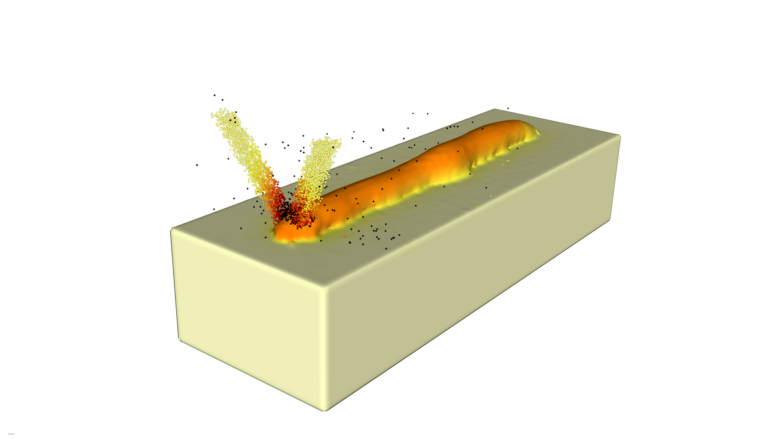
Computational fluid dynamics (CFD) simulation supplies an in depth view of the bodily phenomena throughout Three-D printing. It without delay fashions the soften pool fluid dynamics because the laser interacts with the steel powder. CFD device supplies a degree of keep watch over and accuracy that can not be replicated via dimension or lower-fidelity fashions.
Greater than 40 years in the past, C.W. Hirt, the founding father of Float Science, established a computational methodology for monitoring the evolution of an interface between two fluids with greatly other densities — such because the loose floor between air and water. This method, known as the Quantity of Fluid (VOF) means, is the basis of Hirt’s industrial CFD device, FLOW-Three-D. Since its authentic building, FLOW-Three-D and the VOF means were utilized in analysis and design processes for a spread of packages, akin to dam spillways, high-pressure die castings, and inkjet microfluidics.
Within the final decade, Float Science engineers carried out the VOF technique to soften pool dynamics within the steel AM business. The end result was once FLOW-Three-D AM, which mixes the fluid solver in FLOW-Three-D with laser physics and powder dynamics to type the entire technique of powder settling, spreading, melting, and solidification in laser powder mattress fusion (LPBF) and directed power deposition (DED), at the side of the dynamics of non-laser-based AM processes, akin to binder jetting and materials extrusion.
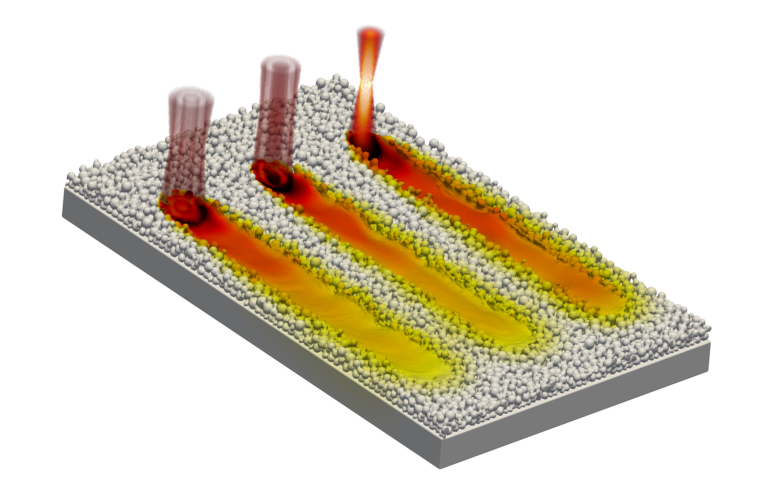
In LPBF, steel powder is unfold over a construct plate and therefore melted via a laser beam into a particular trend. The method is repeated loads or 1000’s of occasions to construct an element layer via layer. The use of the discrete component means (DEM), engineers can simulate the powder settling and spreading procedure intimately via accounting for the particle collisions, powder dimension distribution, and geometry results of the blade or curler that spreads and packs the powder layer.
As soon as the powder mattress is generated, a CFD simulation fashions the laser-material interplay throughout the melting procedure. To try this correctly, engineers will have to account for the huge frame of related physics, together with the viscosity of molten steel, floor pressure, warmth switch, laser mirrored image and absorption, section exchange, flinch stress, and solidification, amongst others. Obviously, there’s a lot happening.
The norm in steel additive production is to make use of thermomechanical simulations to expect part-scale stresses and distortions. Whilst helpful, those fashions are decrease constancy in nature and can not correctly expect monitor geometry and defects, akin to keyholing, balling, porosity, and loss of fusion, that are all associated with the evolution of the soften pool. Procedure parameters will have to be optimized to cut back the formation of defects and supply a low scrap charge for additively manufactured portions to compete within the business.
Via adjusting the method enter parameters, akin to laser energy and velocity, scan trail, beam form, and powder dimension distribution, within the device, researchers and engineers obtain deeper insights into the bodily phenomena at play in the back of the method problems, which will then force the advance of procedure parameter home windows.
Take into account that high-fidelity modeling is restricted via its excessive computational value. The massive selection of physics being solved for is computationally extensive, which means that simulations are restricted to the mesoscale — monitor lengths at the order of millimeters and single-digit layers. The device additionally does indirectly clear up for rigidity and microstructure formation, despite the fact that data will also be received about each the usage of the correct thermal knowledge from a simulation in different fashions.
In spite of those boundaries, the price of the guidelines bought the usage of high-fidelity modeling gear like CFD is an order of magnitude upper than that received from lower-fidelity, part-scale gear. However for the reason that AM procedure comes to more than one scales, procedure design will have to depend on more than one gear. As of now, there’s no modeling instrument that may do the whole thing engineers want, so integration is essential. Each and every corporate or college makes use of other dimension, simulation, and in-situ procedure gear, and it’s crucial that those gear can keep up a correspondence with every different.
“The overpowering selection of procedure parameters in AM requires automatic optimization gear in response to physics-driven simulations,” mentioned Marcin Serdeczny, Ph.D., CFD engineer at Float Science. “To greatly scale back the associated fee and time of recent trends, we will not depend on a trial-and-error experimental way. Gear like FLOW-Three-D AM are precisely a step in that route.”
Because the steel Three-D printing business advances, high-fidelity simulation gear will play a good larger position in production. With persevered developments in computing energy, materials science, and gadget studying, the accuracy and features of those simulation gear will handiest support.
FLOW-Three-D
flow3d.com