
 KUMARAN. V
The emerging acclaim for self sufficient cars has spurred important analysis passion within the maritime trade, specifically for the improvement of maritime self sufficient floor ships (MASS). An crucial requirement of MASS is the power to observe a pre-determined route at sea, bearing in mind components corresponding to stumbling blocks, water intensity, and send maneuverability. Any deviation from this route, say, because of hostile climate stipulations, poses critical dangers like collision, touch, or grounding incidents. It’s thus fascinating for self sufficient ships to have a mechanism in position for successfully resisting deviations.
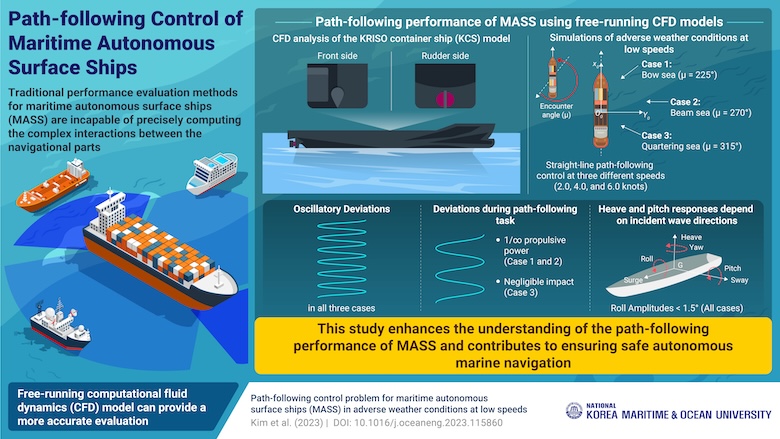
Present strategies for assessing the path-following efficiency of self sufficient ships, alternatively, depend on simplified mathematical send fashions. Sadly, those fashions are not able to seize the difficult interactions between the hull, propeller, rudder, and exterior a whole lot of ships, resulting in faulty estimates of path-following efficiency.
Moreover, according to the World Maritime Group’s Power Potency Design Index to cut back greenhouse fuel emissions, the Marine Setting Coverage Committee has supplied tips to decide the minimal propulsion energy required to deal with send maneuverability in hostile climate stipulations.
In gentle of those tips and the desire for assessing path-following efficiency, a multinational group of researchers, led via Assistant Professor Daejeong Kim from the Department of Navigation Convergence Research on the Nationwide Korea Maritime & Ocean College, has just lately studied the path-following efficiency of MASS the use of a free-running computational fluid dynamics (CFD) mannequin blended with the line-of-sight (LOS) steering device, at low speeds underneath hostile climate stipulations.
“We hired a CFD mannequin in accordance with an absolutely nonlinear unsteady Reynolds-Averaged Navier-Stokes solver that may incorporate viscous and turbulent results and the loose floor answer crucial to path-following issues, enabling a greater prediction of path-following efficiency,” elaborates Dr. Kim. Their findings have been made to be had on-line on September 25, 2023, and printed in Quantity 287, Phase 2 of the magazine Ocean Engineering on November 01, 2023.
The group hired the CFD-based research on the preferred KRISO container send mannequin supplied with the self sufficient LOS steering device. The hostile climate stipulations have been modeled as disturbances from the bow, beam, and quartering sea waves, and those 3 circumstances have been studied at 3 other speeds to spot the impact of ahead speeds at the path-following efficiency.
Simulations printed that the send skilled oscillatory deviations in all of the 3 circumstances. With regards to the bow and beam waves, those deviations diminished with an building up in propulsion energy. Curiously, relating to quartering waves, there used to be a negligible impact of propulsion energy at the deviations. Moreover, the heave and pitch responses of the send have been closely influenced via the route of the incident waves. Moreover, in all 3 circumstances, the roll amplitudes have been constantly under 1.5°. Alternatively, the group may just no longer verify the effectiveness of accelerating velocity in bettering path-following efficiency.
Elaborating at the implications of those findings, Dr. Kim stated, “The proposed CFD-based mannequin may give a treasured contribution to improving the protection of self sufficient marine navigation. Additionally, it could additionally be offering cheap choices to model-scale free-running experiments or full-scale sea trials.”
In abstract, this learn about establishes a basis for inspecting the path-following efficiency of MASS at low speeds in hostile climate stipulations and may just assist in making sure more secure self sufficient marine navigation.